Stop Using AI Only to Get Things Done
AI has changed the way we work. We can now ask AI to write code, prepare reports, explain complex topics, analyze data, create presentations, and solve problems within seconds.
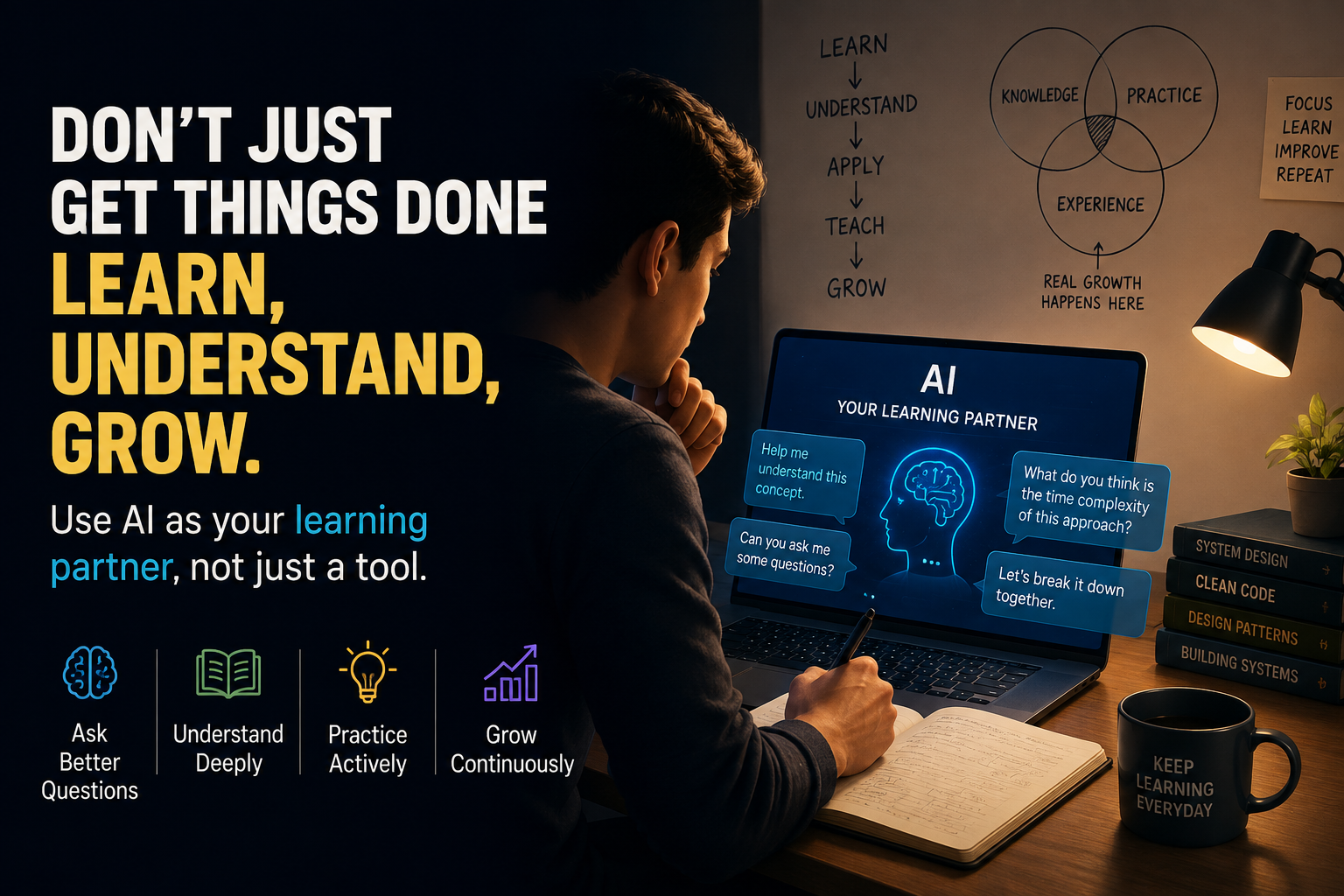
AI has changed the way we work.
We can now ask AI to write code, prepare reports, explain complex topics, analyze data, create presentations, and solve problems within seconds.
That is powerful.
But there is a question we should all ask ourselves:
Are we using AI to become more capable, or are we simply becoming more dependent on it?
There is a big difference.
AI as a Worker vs. AI as a Teacher
Imagine a software engineer needs to build an authentication system.
They can ask:
"Build this authentication API for me."
AI will generate the code. The task gets done.
But there is another approach:
"Teach me how to design this authentication system. Don't give me the complete solution yet. Ask me questions, let me propose an architecture, and then review my approach."
Now AI is not just doing the work.
AI is helping the engineer learn how to do the work.
That mindset can completely change how we use AI.
5 Ways to Use AI for Learning
1. Use AI as a Personal Tutor
Instead of simply asking:
"Explain AWS."
Try:
"Assess my current AWS knowledge, identify my weak areas, and create a learning path. Teach me through questions and real-world scenarios."
AI can adapt the learning process to your level.
2. Ask Questions Before Answers
Don't always ask AI for the solution.
Try:
"Don't give me the answer immediately. Ask me questions that help me reach the answer myself."
This keeps your brain involved instead of turning you into a passive reader.
3. Let AI Challenge Your Thinking
Suppose you decide to use microservices.
Don't ask:
"Is microservices a good choice?"
Ask:
"Act as a senior architect and challenge my decision. Tell me why a modular monolith might be better."
You learn to see trade-offs rather than simply accepting the first answer.
4. Turn Real Problems Into Learning
Suppose your production server suddenly becomes slow.
Instead of asking:
"Fix my server."
Try:
"Act as a senior system engineer. Guide me through troubleshooting this problem step by step. Don't give me the solution immediately. Ask what information I should collect and review my reasoning."
Now a production problem becomes a learning opportunity.
You are not only fixing the problem.
You are learning how experienced engineers approach problems.
5. Test Yourself
After learning something, explain it to AI in your own words.
Then ask:
"Review my explanation. Find my mistakes, missing concepts, and misconceptions."
This is much more effective than simply reading another AI-generated explanation.
A Simple Learning Formula
Use AI with this cycle:
Learn → Recall → Practice → Solve → Review → Improve
For example, if you are learning System Design:
Ask AI to explain a concept.
Explain it back in your own words.
Ask for a real-world scenario.
Design the solution yourself.
Ask AI to challenge your architecture.
Learn from your mistakes.
Now you're not just consuming information.
You're building knowledge and judgment.
The Real Danger of AI
AI can create an illusion of learning.
You read a beautifully written explanation and think:
"I understand this."
But if AI disappears, can you explain it yourself?
Can you solve a similar problem?
Can you apply the concept to a new situation?
If not, you may have experienced familiarity, not understanding.
So ask yourself:
"If AI disappeared right now, could I still do this myself?"
If the answer is no, use AI to practice — not just to provide another answer.
Final Thought
AI should not simply make us faster.
It should make us better.
Use AI as a worker when you need productivity.
Use it as a teacher when you need knowledge.
Use it as a thinking partner when you need better judgment.
The next time you are about to ask:
"AI, do this for me."
Pause for a moment and ask:
"Can AI help me learn how to do this better myself?"
Because the real advantage of AI is not that it can do more work for us.
The real advantage is that we can use it to become capable of doing more ourselves.
So don't just use AI to finish the task.
Use AI to become better at the task.
That is how we make sure AI doesn't replace our ability to think —
but helps us think better.