SLI → SLO → SLA
The Foundation of Service Reliability: SLI → SLO → SLA
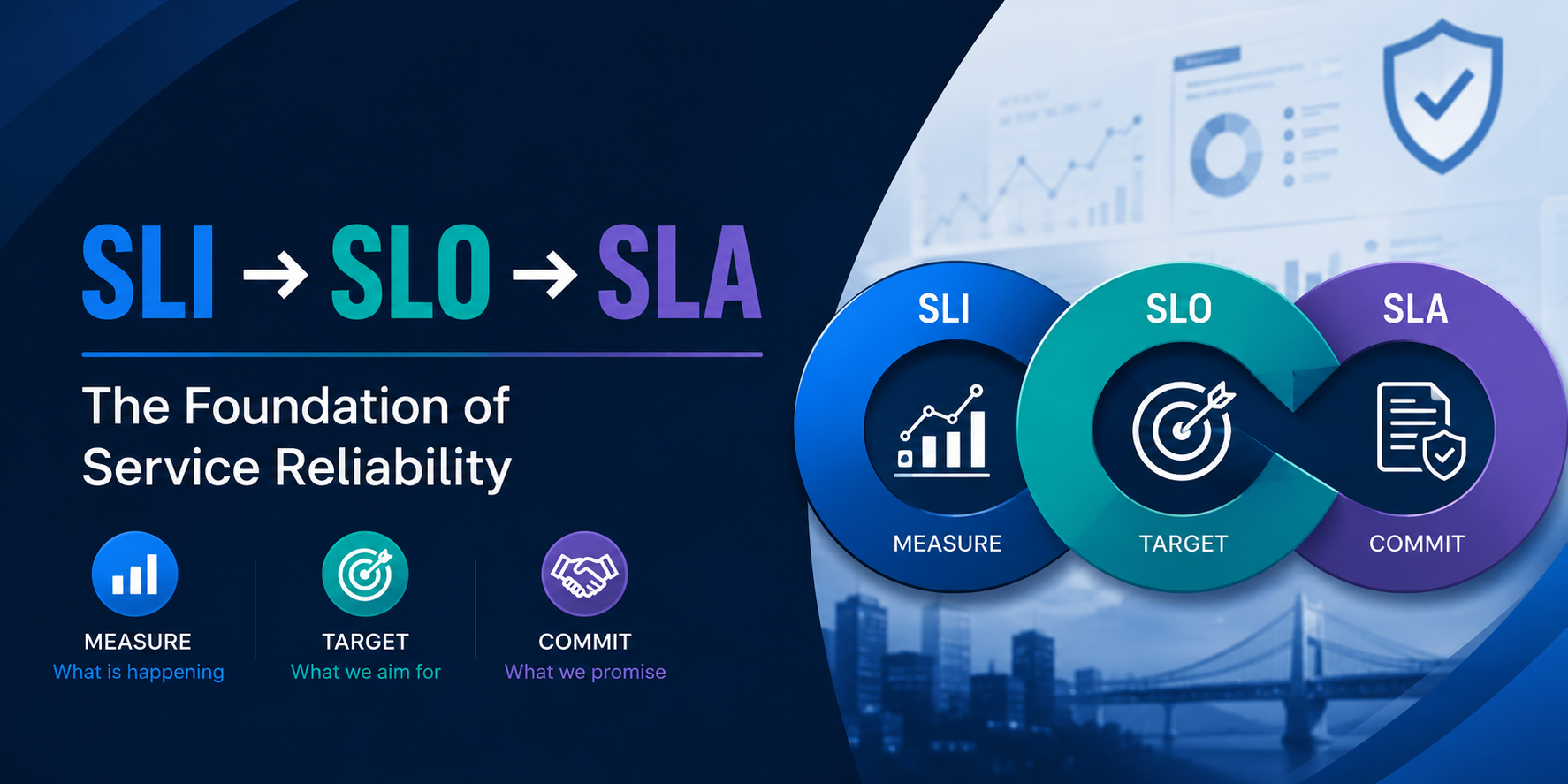
In modern DevOps, reliability is not simply about keeping servers running. It is about defining measurable service expectations, monitoring them continuously, and making informed decisions based on operational data.
Three concepts provide the foundation for this:
SLI → SLO → SLA
Understanding the difference is important not only for System Engineers, but also for Project Managers who are responsible for delivery, risk, customer expectations, and service quality.
SLI — Service Level Indicator
An SLI is a quantitative measurement of actual service performance.
Typical SLIs include:
Availability
Request success rate
Latency
Error rate
Throughput
Data freshness
For example, if an application processes 1 million requests in a month and 999,000 are successful:
SLI = 99.9% successful requests
The SLI tells us what actually happened.
SLO — Service Level Objective
An SLO defines the reliability or performance target for a service.
For example:
API availability: 99.9% per month
or
95% of requests must complete within 300 ms.
SLOs are primarily an engineering and operational management tool. They help teams decide where to invest engineering effort and when reliability needs to take priority over new feature delivery.
In simple terms:
SLI = Actual performance
SLO = Target performance
SLA — Service Level Agreement
An SLA is the formal commitment made to a customer or business stakeholder.
For example:
The service will maintain 99.5% monthly availability.
An SLA may include contractual consequences such as service credits or other remedies if the commitment is not achieved.
This makes SLA different from SLO:
SLO is an engineering objective.
SLA is a business/customer commitment.
A Practical Example
Consider an online booking platform.
During a particular month:
SLI: 99.85% availability
SLO: 99.9% availability
SLA: 99.5% availability
The service met the contractual SLA, but it missed the internal SLO.
From a System Engineering perspective, this should trigger investigation:
What caused the availability degradation?
Was it infrastructure, application, database, or dependency related?
Did a deployment cause the incident?
Do we need additional monitoring or automation?
Is there a recurring reliability pattern?
From a Project Management perspective, the same information becomes a delivery and risk management signal.
For example:
"The service remains within the customer SLA, but the internal SLO has been breached. We should prioritize the identified reliability issue before increasing release risk."
This is a much stronger management conversation than simply saying:
"The system is stable."
Why This Matters to Our Teams
For System Engineers, SLI and SLO provide measurable operational objectives.
For Project Managers, they provide objective information for managing:
Delivery risk
Release decisions
Operational risk
Customer expectations
Technical debt
Infrastructure investment
It also creates a common language between Engineering, Project Management, and Business teams.
Instead of discussing reliability based on perception, we can discuss it based on measurable objectives.
Don't Confuse SLO with "99.999% Everything"
A common mistake is assuming that higher availability is always better.
It isn't necessarily.
Moving from 99.9% to 99.99% availability significantly reduces the allowed downtime and usually requires additional investment in:
Architecture
Redundancy
Monitoring
Automation
Testing
Operational processes
The right question is not:
"How do we achieve the highest possible availability?"
It is:
"What level of reliability does the business actually require, and what is the cost of achieving it?"
That is where engineering judgment and business priorities need to meet.
The Manager's Perspective
A mature DevOps organization doesn't treat monitoring as simply a collection of dashboards.
We define:
SLI — What are we measuring?
SLO — What level of reliability do we expect?
SLA — What have we committed to our customers?
Then we use these metrics to drive engineering and business decisions.
The objective is not simply to keep systems running.
The objective is to build services that are measurably reliable, operationally sustainable, and aligned with business expectations.
SLI → Measure
SLO → Target
SLA → Commit
That mindset is at the heart of effective DevOps and SRE practices.