Cloud Architecture Is More Than Choosing Cloud Services
Understanding the Real Value of a Consistent, Operable Cloud Environment
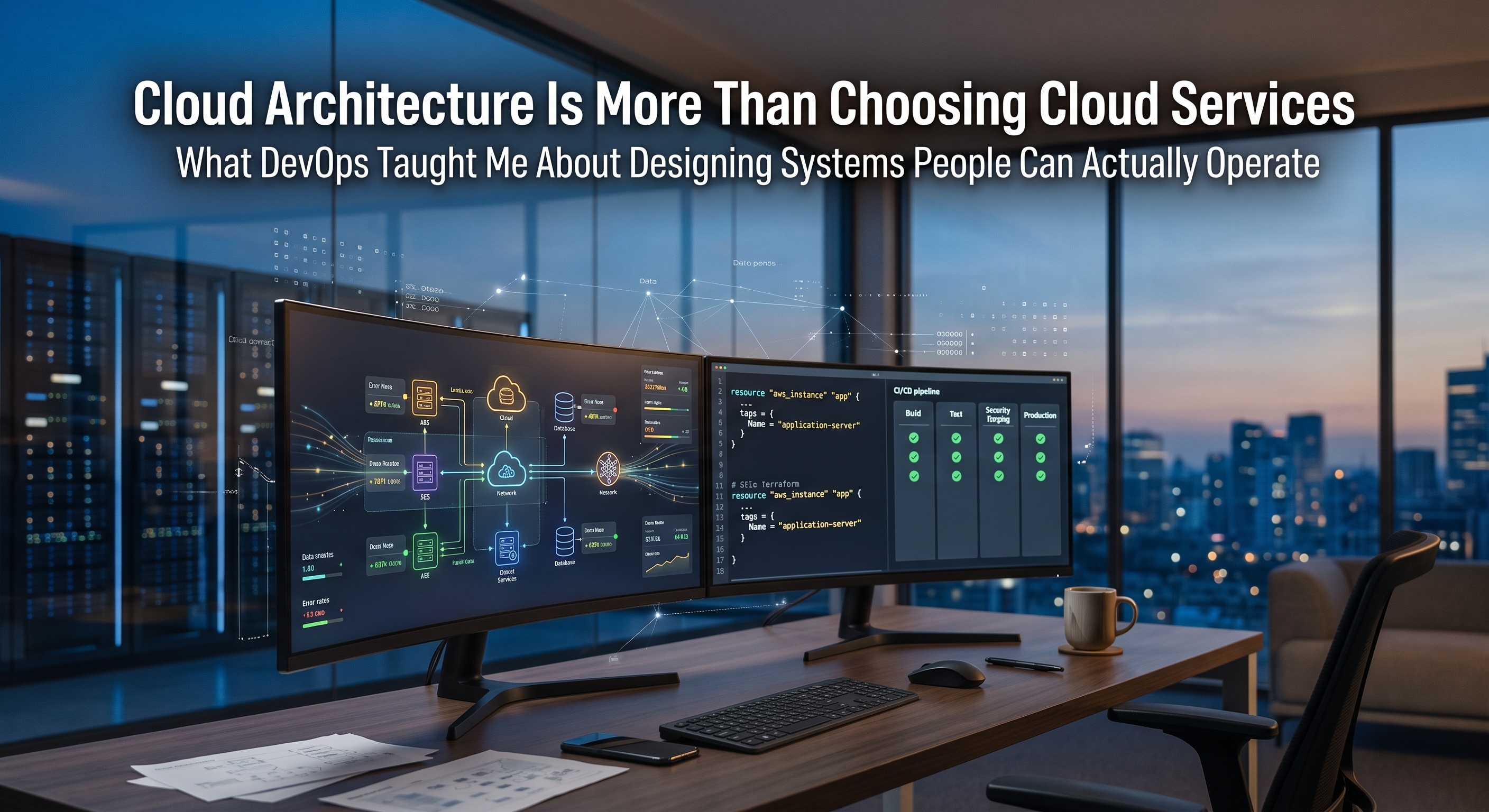
Building scalable cloud architecture is less about picking items off a cloud provider's service menu and more about designing systems that engineering teams can reliably operate, observe, and evolve under failure conditions.
1. Shift Focus: System Requirements Over Cloud Catalogs
When designing a cloud system, jumping straight to service selection (e.g., EKS vs. EC2, RDS vs. DynamoDB) shifts focus to tooling rather than systemic behavior. Architectural decisions must be driven by operational requirements before choosing building blocks.
User Dynamics: Who are the users, where are they located, and what are their usage patterns?
Scalability & Load: How does the system handle sudden 10x traffic spikes?
Failure Modes: What happens when an application node crashes, a database connection pool depletes, or an entire Availability Zone goes down?
Data & Recovery: What data is stored, how sensitive is it, and what are the required Recovery Time Objectives (RTO) and Recovery Point Objectives (RPO)?
Human Factors: Who will maintain and debug this system six months from now, and what is the team's operational overhead capacity?
2. The Hidden Reality of Basic Diagrams
A standard web architecture looks straightforward on paper:
                 Internet
                    |
                    v
           DNS / CDN / WAF
                    |
                    v
          Application Load Balancer
                    |
         +----------+----------+
         |                     |
         v                     v
    App Instance 1        App Instance 2
         |                     |
         +----------+----------+
                    |
                    v
             Database Layer
                    |
         +----------+----------+
         |                     |
         v                     v
     Object Storage         In-Memory Cache
The Architectural Challenge: Architecture does not live in static boxes and arrows. It exists in the failure scenarios between those boxes: cache eviction storms, deployment bugs, regional outages, and connection limit bottlenecks.
3. The 7 Operational Pillars of Cloud Architecture
DevOps bridges the gap between static architecture diagrams and live production environments. System design should evaluate every decision against seven core operational pillars:
Pillar | Core Operational Focus | Implementation Strategy |
|---|---|---|
Reliability | Fault tolerance during partial failures | Multi-AZ deployments, circuit breakers, auto-healing |
Security | Identity isolation & data protection | Principle of least privilege, zero-trust network policies, secrets management |
Scalability | Graceful handling of increased load | Stateless application tiers, horizontal autoscaling, read-replicas |
Observability | Visibility into internal system state | Centralized telemetry across logs, metrics, and distributed tracing |
Deployability | Predictable, low-risk software delivery | CI/CD automation, immutable artifacts, blue/green or canary releases |
Cost | Alignment between usage and business value | Right-sizing, auto-scaling down off-peak, resource tag governance |
Recoverability | Restoring state post-catastrophe | Automated infrastructure provisioning, continuous database backups |
4. Infrastructure as Code (IaC)
Manual infrastructure configuration ("click-ops") introduces configuration drift, human error, and unknown dependencies. Treating infrastructure as code ensures that environment creation is idempotent, version-controlled, and reviewable through code reviews.
# Example declarative infrastructure definition
resource "aws_instance" "app_server" {
  ami           = "ami-0c55b159cbfafe1f0"
  instance_type = "t3.micro"

  metadata_options {
    http_tokens = "required" # Enforce IMDSv2 for security
  }

  tags = {
    Name        = "production-app-server"
    Environment = "production"
    ManagedBy   = "terraform"
  }
}
5. Predictable Pipeline Engineering
Deployments should be routine, low-risk events driven by automation rather than manual execution under pressure.
[Developer Push]
       |
       v
[Git Repository] ---> [CI Pipeline] ---> Build -> Test -> Security Scan
                                                              |
                                                              v
[Production] <--- [Staging] <--- [Container Registry] <--- [Container Image]
       |
       v
[Observability & Automated Rollback]
Immutable Artifacts: Build container images or machine images once; promote the exact same artifact through staging and production.
Automated Guardrails: Include static security analysis (SAST), dependency auditing, and automated regression tests in the delivery path.
Rollback Capabilities: Maintain automated rollback triggers tied to error-budget consumption or health-check failures.
6. Embedded Observability
Observability must be built into application and infrastructure design rather than attached post-deployment.
Metrics (Patterns): CPU/memory utilization, request latency (p50, p95, p99), HTTP error rates, active DB connections.
Logs (Events): Structured JSON logs containing contextual identifiers (e.g.,
trace_id,user_id,tenant_id).Traces (Flows): End-to-end request propagation tracking requests across microservices and managed cloud resources.
7. Earned Complexity vs. Technology Collection
The goal of cloud engineering is to meet requirements while minimizing complexity.
Rule of Thumb: Every additional technology, managed service, or abstraction layer added to a system incurs operational tax. Architectural complexity must be earned by explicit functional or non-functional requirements.
Unearned Complexity: Introducing Kubernetes, service meshes, and distributed multi-region databases for a low-traffic internal CRUD app.
Right-Sized Architecture: Leveraging simple managed containers (e.g., AWS App Runner, ECS, or GCP Cloud Run) alongside managed relational databases until traffic and operational scope dictate further decomposition.
Cloud architecture defines how a system should function; DevOps ensures that same system survives contact with reality. System design achieves maturity when engineers design for failure, automate deployment friction, and prioritize operational simplicity over technical novelty.