Building Effective Leadership Relationships: From Directors to Team Members
A strong leadership structure is not simply about hierarchy. It is about creating clarity, trust, ownership, communication, and continuous improvement at every level.
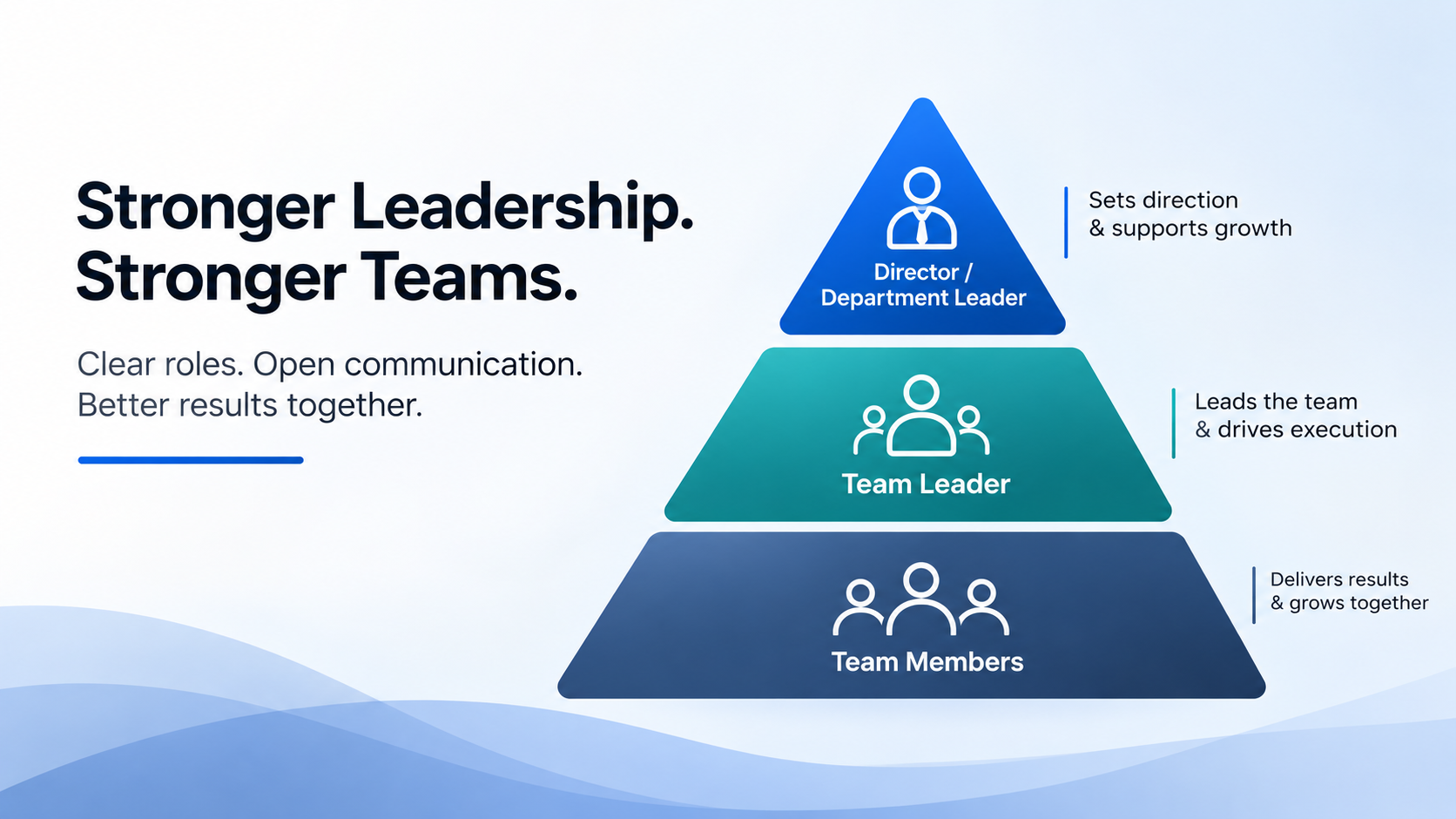
As organizations grow, effective communication between Department Leaders, Team Leaders, and Team Members becomes increasingly important.
Each level has different responsibilities, but they are all connected by the same goal: building a healthy team and delivering better results.
A strong leadership structure is not simply about hierarchy. It is about creating clarity, trust, ownership, communication, and continuous improvement at every level.
1. The Role of a Department Leader / Director
A Department Leader provides the strategic direction and organizational context that teams need.
Their responsibilities may include:
Defining the department's vision and priorities
Setting clear expectations for Team Leaders
Providing resources and organizational support
Removing organizational obstacles
Supporting Team Leaders when difficult decisions arise
Reviewing overall team and department performance
Developing future leaders
Creating a clear direction for the next 1–2 years
A Director does not need to control every task. Instead, the Director should create the environment where Team Leaders can take ownership and lead effectively.
2. The Role of a Team Leader
A Team Leader connects organizational strategy with day-to-day execution.
Their responsibilities may include:
Translating organizational goals into team priorities
Managing workload and priorities
Supporting and developing team members
Monitoring project progress and risks
Facilitating communication within the team
Removing blockers
Coordinating with stakeholders
Encouraging collaboration and knowledge sharing
Continuously improving team processes
A Team Leader should not simply distribute tasks.
Their role is to help the team understand why the work matters, work effectively, and grow together.
3. The Role of Team Members
Leadership is not only the responsibility of managers.
Team Members also play an important role in creating a healthy and effective team.
They should be encouraged to:
Take ownership of their responsibilities
Communicate progress and problems early
Ask questions when requirements are unclear
Share knowledge and ideas
Support other team members
Raise risks and blockers instead of hiding them
Give constructive feedback
Continue developing their skills
Contribute to improving team processes
A strong team member does not simply wait for instructions. They gradually develop the confidence to identify problems, propose solutions, and take ownership.
4. The Relationship Between the Three Levels
A healthy organization should not operate as a one-way command structure.
Instead, information and support should flow in both directions.
Department Leader / Director
Provides Vision, Direction, Context & Support
↓
Team Leader
Provides Execution, Coordination, Coaching & Ownership
↓
Team Members
Provide Delivery, Expertise, Feedback & Continuous Improvement
But the communication should also flow upward:
Team Members → Team Leader → Department Leader
Problems, ideas, risks, and feedback should be able to move upward without unnecessary barriers.
5. Make 1-on-1 Meetings Meaningful
1-on-1 meetings are an important part of this relationship.
A Director's 1-on-1 with a Team Leader should not become only a task or fault-finding session.
Useful topics include:
Team performance
Project progress
Risks and challenges
Team workload and morale
Leadership development
Future goals
Organizational challenges
Support needed from management
Similarly, a Team Leader's 1-on-1 with a Team Member should focus not only on tasks, but also on motivation, challenges, development, and career growth.
One powerful question for a leader is:
“What can I do to help you perform and grow more effectively?”
This changes the relationship from simple evaluation to partnership.
6. Build Trust at Every Level
Trust is important at every level of an organization.
A Team Member should feel comfortable telling their Team Leader:
“I am blocked.”
A Team Leader should feel comfortable telling the Director:
“We have a serious risk.”
And a Director should respond with:
“Let's understand the problem and work on a solution.”
This creates a healthy cycle:
Problem → Early Communication → Discussion → Support → Solution
When people are afraid of being blamed, problems tend to remain hidden until they become much more difficult to solve.
7. Give Constructive Feedback
Feedback is essential for growth at every level.
Effective feedback should be:
Specific → Objective → Actionable
Instead of simply pointing out a problem, discuss:
What happened
Why it matters
What could be improved
What support is needed
Good feedback should create learning and improvement, not fear or defensiveness.
8. Align on the Future
Leadership should not focus only on today's tasks.
Department Leaders and Team Leaders should regularly discuss:
“Where do we want our team to be in the next 1–2 years?”
Then consider:
What capabilities do we need?
What skills should we develop?
What processes should improve?
What technology could help us?
What responsibilities should Team Leaders and Members take?
What support is needed from management?
This helps everyone understand not only what they are doing today, but where they are going tomorrow.
9. Encourage Continuous Learning
Technology, business requirements, and customer expectations constantly change.
Organizations should therefore encourage continuous learning at every level.
This could include:
Cloud and infrastructure
DevOps and automation
Security
System architecture
Project management
Agile practices
Communication
Leadership
Domain knowledge
Learning should not be viewed only as an individual benefit. A stronger individual creates a stronger team, and a stronger team creates a stronger organization.
The Goal: One Team, Different Responsibilities
A healthy organization can be represented simply as:
Department Leader / Director
🎯 Vision & Strategic Direction
↓
Team Leader
🧭 Execution & People Leadership
↓
Team Members
⚙️ Delivery & Expertise
And across all levels:
↕ Communication
↕ Feedback
↕ Trust
↕ Support
↕ Continuous Improvement
The Director doesn't need to control every decision.
The Team Leader doesn't need to solve every problem alone.
And Team Members shouldn't feel that they are simply receiving instructions.
Everyone should understand their role, responsibility, authority, and contribution to the larger goal.
Final Thought
Great leadership is not about controlling every decision or finding faults in people.
It is about creating clarity, empowering people to take ownership, giving constructive feedback, supporting growth, and building trust across every level of the organization.
When Directors, Team Leaders, and Team Members understand their roles and communicate openly, the organization becomes more resilient, collaborative, and capable of continuous improvement.
A Director provides direction. A Team Leader turns direction into execution. Team Members turn execution into results. Everyone contributes to building the team.
That is how strong teams—and eventually strong organizations—are built.