AI for Scrum Masters: From Administrative Work to Better Facilitation
Artificial Intelligence is changing the way teams work, and Scrum Masters are no exception. It can help Scrum Masters become more effective.
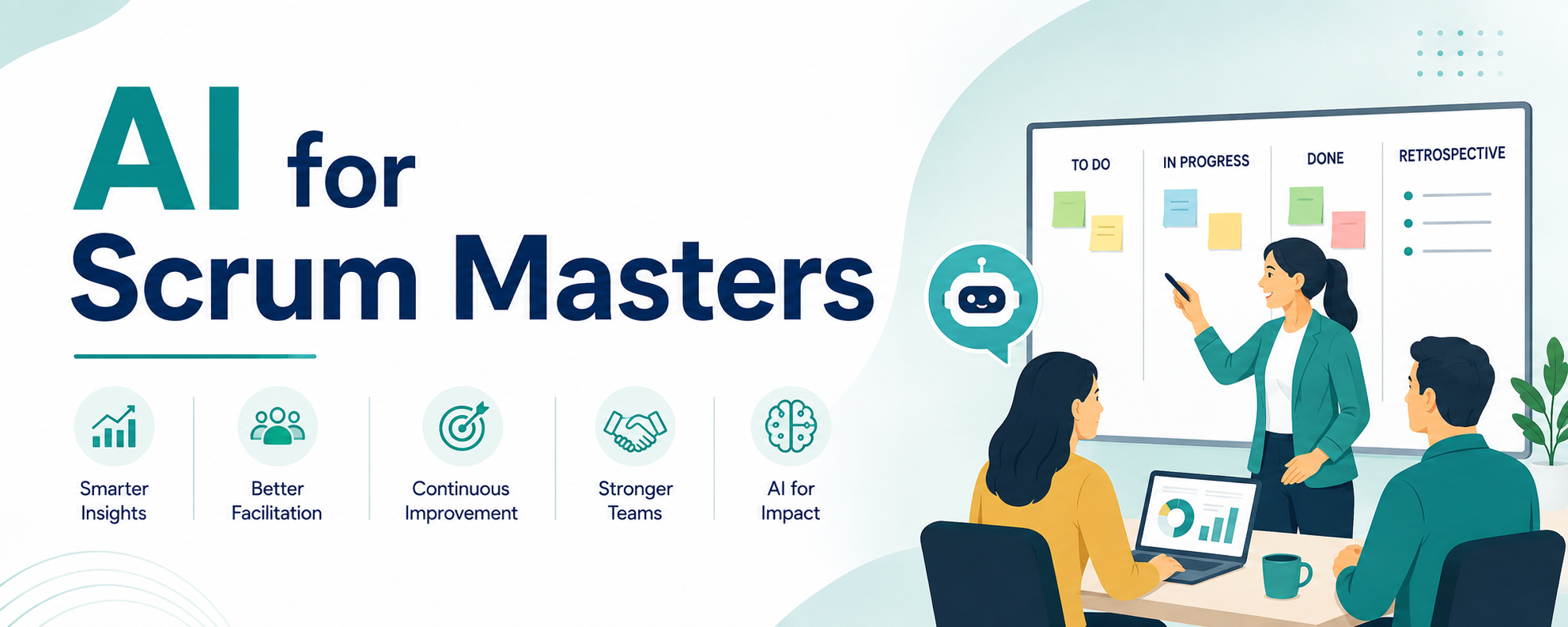
Artificial Intelligence is changing the way teams work, and Scrum Masters are no exception.
But AI is not here to replace the Scrum Master.
It can help Scrum Masters become more effective.
A significant part of a Scrum Master's time can be spent collecting information, preparing reports, analyzing sprint results, organizing retrospectives, tracking blockers, and following up on action items.
AI can help reduce much of this administrative workload.
How Can Scrum Masters Use AI?
1. Sprint Analysis
Instead of manually reviewing every task and update, AI can help analyze sprint data and identify patterns such as:
Frequently carried-over tasks
Recurring blockers
Unexpected scope changes
Estimation problems
Work distribution issues
Bottlenecks in the development process
For example:
"Analyze this sprint data and identify the three biggest reasons we did not complete our planned work. Suggest practical improvements for the next sprint."
This can turn raw data into useful insights.
2. Better Retrospectives
AI can help Scrum Masters prepare more meaningful retrospective questions based on what actually happened during the sprint.
For example:
"Our team completed most of the sprint, but several tasks were blocked by dependencies. Suggest retrospective questions that help us understand the root cause without blaming individuals."
AI can also help group retrospective feedback into themes such as process, communication, technical debt, dependencies, and planning.
3. Tracking Action Items
One common problem with retrospectives is that good ideas are discussed but forgotten afterward.
AI can help summarize:
What happened → What we learned → What we will change → Who owns it → When we will review it
This makes continuous improvement more actionable.
4. Identifying Team Patterns
Over several sprints, AI can help identify patterns that may be difficult to notice manually.
For example:
"Review the last six sprints and identify recurring blockers, planning issues, and improvement themes."
The goal isn't to judge individual team members.
The goal is to understand how the system of work is performing.
But There Is an Important Limitation
A Scrum Master should never blindly accept AI's conclusions.
AI can analyze data.
It cannot fully understand the emotions, relationships, trust, motivation, organizational politics, or personal circumstances behind that data.
For example, AI might identify that one developer consistently completes fewer tasks.
But the real reason could be:
They are helping other team members.
They are working on technically complex tasks.
Requirements are unclear.
They are supporting production issues.
The team has an unhealthy workload distribution.
Only human interaction can reveal the real story.
The Best Combination
The strongest approach is:
AI for data + Scrum Master for people.
Let AI handle more of the repetitive analysis and administrative work.
Let the Scrum Master focus more on:
Facilitation
Coaching
Communication
Removing impediments
Building trust
Improving collaboration
Helping the team become self-managing
AI can tell you what might be happening.
A good Scrum Master helps the team understand why it is happening and what to do about it.
Final Thought
The future Scrum Master may not be the person who manually prepares the best sprint report.
It may be the person who knows how to combine AI-driven insights with human-centered leadership.
Use AI to reduce the administrative burden.
Use the time you save to talk to your team, ask better questions, understand the real problems, and create an environment where the team can continuously improve.
AI can analyze the sprint.
AI can summarize the retrospective.
AI can identify patterns.
But people still improve people.